
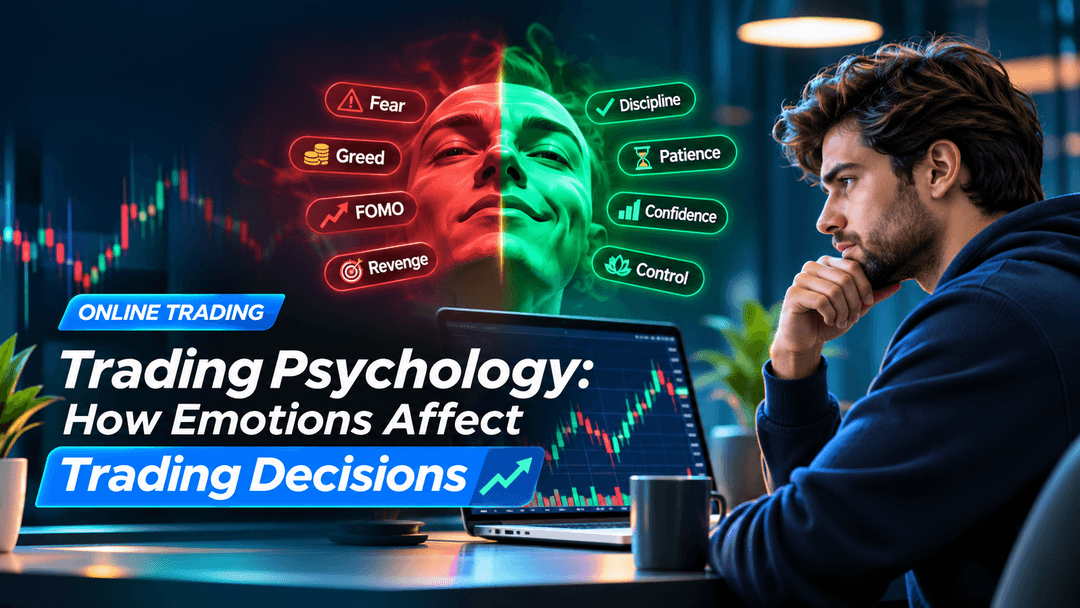
Trading Psychology: How Emotions Affect Trading Decisions
A trader may understand price charts, technical indicators, and market trends but still make poor decisions when emotions take control. Fear can lead to exiting positions impulsively, while greed may encourage excessive risk-taking.
This is why trading psychology is an important part of financial market education.
Trading psychology explains how emotions, habits, expectations, and cognitive biases influence decisions in forex, stock, and cryptocurrency markets.
Understanding these influences does not guarantee profitable results. However, it can help beginners recognize impulsive behavior, evaluate decisions more objectively, and develop consistent risk management habits.
This guide explores common trading emotions, their effects on decision-making, and practical ways to build a more disciplined trading approach.
What Is Trading Psychology?
Trading psychology refers to the emotional and mental factors that influence how people make financial trading decisions.
These factors include fear, greed, confidence, frustration, patience, and attitudes toward uncertainty.
For example, someone may identify a trading opportunity using a carefully prepared plan but abandon that plan after seeing an unexpected price movement.
Another person might take an unnecessarily large position after experiencing several successful trades.
Both situations demonstrate how emotions can influence behavior independently of market analysis.
Why Does Trading Psychology Matter?
Financial markets involve uncertainty, and no individual trade has a guaranteed outcome.
Emotional reactions can interfere with how people interpret information and assess risk.
Understanding trading psychology can help learners:
Recognize impulsive decisions
Identify emotional triggers
Follow predefined trading procedures
Evaluate losses without immediately reacting
Maintain consistent risk awareness
Review decisions more objectively
The goal is not to eliminate emotions but to prevent them from becoming the only basis for financial decisions.
How Fear Affects Trading Decisions
Fear is a natural response to uncertainty and potential financial loss.
In trading, it can influence decisions in several ways.
Fear of Losing Money
Some beginners become uncomfortable when prices move against their expectations.
They may close a position earlier than planned, even when the original analysis has not materially changed.
However, exiting early is not automatically a mistake. Reducing exposure may be appropriate when the risks or underlying assumptions change.
Fear of Missing Out (FOMO)
FOMO occurs when someone feels pressured to participate because others appear to be benefiting from a market movement.
For example, a trader may see a currency pair rising rapidly and enter without evaluating the price, exposure, or market conditions.
The decision is driven by urgency rather than a structured process.
A useful way to address FOMO is to recognize that missing an opportunity does not create a financial loss.
How Greed Influences Trading Behavior
Greed can encourage traders to seek increasingly large gains without properly evaluating the associated risks.
This may happen after a series of favorable outcomes.
Common Greed-Driven Decisions
Examples include:
Increasing position sizes beyond planned limits
Taking additional trades without a clear reason
Ignoring previously established exit conditions
Using excessive leverage
Assuming recent success will continue
Consider a hypothetical trader who increases their position size after three successful trades.
If the next movement is unfavorable, the larger exposure may create a loss that exceeds the gains from previous positions.
The example illustrates why confidence should not replace risk assessment.
Understanding Revenge Trading
Revenge trading occurs when someone attempts to recover a financial loss through immediate or unusually aggressive trading.
It often begins with frustration after an unexpected outcome.
Instead of reviewing what happened, the person enters another position primarily to recover the money.
Why Revenge Trading Is Risky
This behavior can lead to:
Unplanned entries
Larger position sizes
Repeated losses
Poor attention to market conditions
Greater emotional pressure
A predetermined stopping rule can help interrupt this behavior.
The purpose of stopping is to restore a structured decision process, not to guarantee that future trades will succeed.
For a broader explanation of risk limits, see Forex Risk Management: Position Sizing and Common Beginner Mistakes.
Overconfidence and the Illusion of Control
Overconfidence occurs when someone overestimates their knowledge or ability to predict outcomes.
In trading, it may develop after several successful positions.
A trader might begin believing their strategy is unusually accurate and reduce attention to unfavorable scenarios.
However, short periods of success can occur partly because of chance or temporary market conditions.
Recognizing Overconfidence
Warning signs may include ignoring contrary evidence, increasing leverage without justification, and assuming that a familiar chart pattern must produce the same outcome again.
Reviewing a larger sample of decisions, including unsuccessful ones, can provide a more balanced perspective.
Common Psychological Biases in Trading
Beyond everyday emotions, several cognitive biases can influence financial decisions.
| Psychological Bias | Meaning | Possible Trading Behavior |
|---|---|---|
| Loss Aversion | Losses may feel more significant than equivalent gains | Holding losing positions unnecessarily |
| Confirmation Bias | Favoring information that supports an existing belief | Ignoring contradictory market evidence |
| Overconfidence | Overestimating personal judgment | Increasing unnecessary exposure |
| Recency Bias | Giving recent events excessive importance | Assuming a short winning streak will continue |
| Anchoring | Relying too heavily on an earlier price or expectation | Refusing to reassess a changed market |
Recognizing these patterns can make trading decisions easier to evaluate.
Awareness alone does not eliminate biases, so consistent review and structured procedures remain important.
Trading Psychology vs Technical Analysis
Technical analysis and trading psychology examine different parts of the decision-making process.
| Aspect | Technical Analysis | Trading Psychology |
|---|---|---|
| Main Focus | Historical price behavior | Human behavior and decision-making |
| Common Topics | Trends, patterns, indicators | Fear, greed, discipline, biases |
| Main Question | What is happening on the chart? | Why am I making this decision? |
| Main Limitation | Patterns may fail | Emotional control cannot eliminate market risk |
For example, someone may identify a support level correctly but still take excessive financial exposure because they feel unusually confident.
Understanding both chart analysis and psychological influences is useful.
Beginners can explore the Forex Trading Course at GS Trainings for a curriculum covering technical analysis, trading psychology, and risk management.
How to Develop Emotional Discipline in Trading
Emotional discipline involves making deliberate decisions instead of responding impulsively to every market movement.
Several practical habits can support this approach.
1. Prepare a Written Trading Plan
A trading plan should describe the conditions under which a position would be considered, the intended exposure, and reasons for exiting.
Writing down these conditions makes it easier to identify deviations from the original plan.
2. Set Financial Risk Limits
Establishing exposure limits helps prevent emotional decisions from creating unnecessarily large financial risks.
Position sizing, leverage, and stop-loss limitations should be understood together.
No predefined rule can guarantee a maximum loss under every market condition.
3. Avoid Constant Chart Monitoring
Watching every small price movement can increase emotional pressure.
Instead, use review intervals appropriate to the learning exercise or trading approach.
Stepping away from a chart may be especially useful when frustration or urgency is affecting judgment.
4. Accept Uncertainty
Every market analysis contains uncertainty.
A losing outcome does not necessarily mean the original reasoning was irrational, just as a profitable outcome does not prove that a decision was sound.
Evaluate the quality of the decision separately from its financial result.
5. Practice Before Committing Real Money
Historical chart exercises and educational simulations allow beginners to review decisions without immediate financial exposure.
However, simulated trading does not fully reproduce the emotional pressures associated with risking personal money.
How a Trading Journal Improves Decision-Making
A trading journal records the reasoning, circumstances, and outcomes of individual decisions.
It can reveal recurring habits that are difficult to recognize from memory alone.
What Should a Trading Journal Include?
| Journal Field | Example |
|---|---|
| Date and Market | EUR/USD, practice session |
| Decision Reason | Historical support area |
| Planned Risk | Hypothetical $10 |
| Emotional State | Anxious or confident |
| Actual Outcome | Recorded after the session |
| Lessons Learned | Review whether the plan was followed |
The purpose is not to record only winning and losing positions.
A useful journal also identifies whether decisions followed a clear process and whether emotions influenced them.
Common Psychological Mistakes Beginners Should Avoid
Expecting every trade to succeed: Financial markets remain unpredictable.
Following social media excitement: Popular opinions do not establish reliable market analysis.
Trying to recover losses immediately: Emotional urgency can encourage excessive exposure.
Changing rules after every result: Constant changes make it difficult to evaluate a consistent approach.
Ignoring stress and fatigue: Reduced concentration can affect judgment.
Confusing luck with skill: A favorable outcome does not necessarily demonstrate a repeatable process.
Market conditions also differ between asset classes. The GS Trainings comparison of forex vs crypto trading explains differences in volatility, liquidity, and financial risks.
A Practical Four-Week Trading Psychology Roadmap
Beginners can develop emotional awareness through structured educational exercises.
| Week | Learning Focus | Practical Activity |
|---|---|---|
| Week 1 | Fear, greed, and FOMO | Identify emotional reactions to historical charts |
| Week 2 | Trading plans and discipline | Create a simulated decision checklist |
| Week 3 | Loss aversion and overconfidence | Review hypothetical winning and losing scenarios |
| Week 4 | Journaling and self-evaluation | Evaluate decisions and recurring patterns |
The objective is to strengthen decision-making skills rather than achieve a particular financial return.
For learners new to currency markets, How to Learn Forex Trading in Pakistan provides additional background on market fundamentals, financial risks, and education.
Conclusion
Trading psychology helps explain why financial decisions are influenced by more than charts and market information.
Fear, greed, FOMO, revenge trading, and overconfidence can interfere with careful risk assessment and consistent behavior.
Developing a written plan, maintaining a trading journal, recognizing emotional triggers, and accepting uncertainty can support more thoughtful decisions.
For beginners, understanding these psychological factors is an important part of learning about financial markets responsibly.