
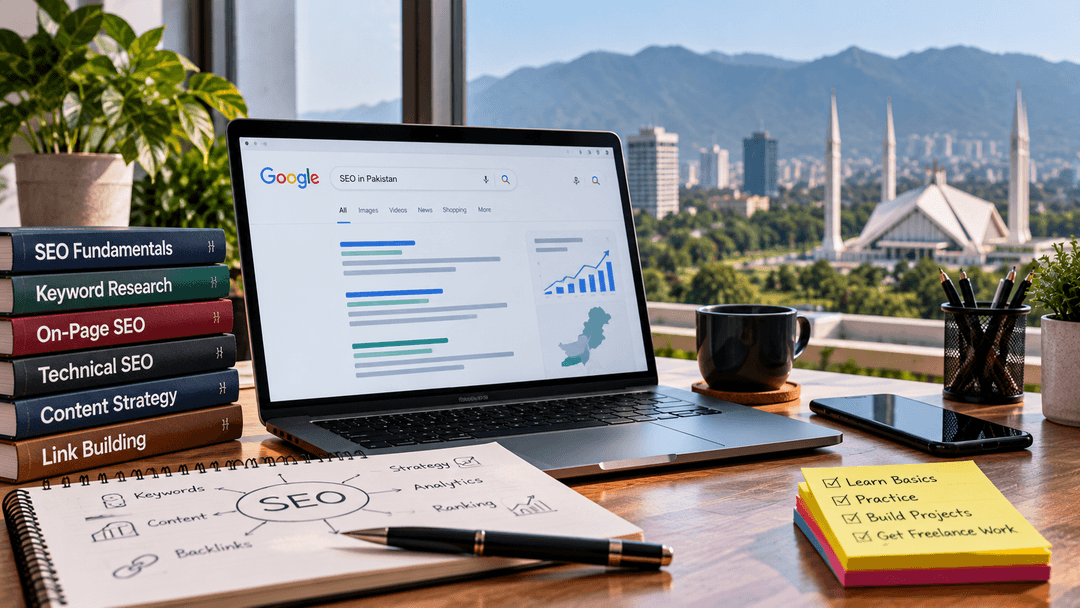

When someone searches Google for a restaurant in Lahore, an online clothing store, or a professional training course, they usually explore the results that appear relevant to their needs. But how do websites become visible in these searches?
Search Engine Optimization, commonly known as SEO, helps websites improve their visibility in organic search results. It combines useful content, website improvements, and an understanding of how search engines discover information.
If you are wondering how to start learning SEO in Pakistan, you do not need a marketing degree or previous technical experience. You can begin with the fundamentals, practice on a website, and gradually develop more advanced skills.
This guide explains essential SEO concepts, beginner-friendly tools, practical exercises, and a learning roadmap for students and aspiring digital marketers.
What Is SEO and How Does It Work?
SEO stands for Search Engine Optimization. It involves improving a website so search engines can discover, understand, and present its content to relevant users.
Search engines use automated systems to find web pages, process their information, and determine which results may best answer a search query.
SEO helps website owners make content accessible, useful, and understandable.
Why Is SEO Important?
Businesses use SEO to help potential customers discover their products, services, and information.
For example, a bakery in Islamabad may want its website to appear when someone searches for birthday cakes nearby.
Effective SEO can support:
Greater visibility in relevant search results
Organic website traffic
Improved website structure and usability
Discovery of useful products and services
Long-term digital marketing activities
However, SEO does not guarantee first-page rankings, immediate traffic, or specific business results.
Understanding the Main Types of SEO
Before exploring individual techniques, beginners should understand the major areas of search engine optimization.
| SEO Type | Main Focus | Practical Example |
|---|---|---|
| On-Page SEO | Content and page elements | Improving headings and titles |
| Technical SEO | Website accessibility and performance | Fixing indexing problems |
| Off-Page SEO | External reputation and references | Earning relevant backlinks |
| Local SEO | Visibility for location-based searches | Optimizing a business profile |
On-Page SEO
On-page SEO focuses on improving content and elements within individual website pages.
It includes useful headings, descriptive titles, relevant keywords, internal links, and clear information.
Technical SEO
Technical SEO helps search engines access and understand website content.
Common topics include crawling, indexing, sitemaps, mobile usability, and canonical URLs.
Off-Page SEO
Off-page SEO involves factors outside your website, including links from other websites and relevant brand mentions.
The goal is to develop genuine visibility and credibility rather than purchase manipulative links.
Local SEO
Local SEO helps eligible businesses improve their presence in location-based searches.
This is particularly relevant to restaurants, educational institutes, clinics, and service providers across Pakistan.
Step 1: Learn How Google Search Works
Understanding search engines should come before learning advanced optimization techniques.
Three important concepts are crawling, indexing, and ranking.
Crawling: Search engines discover pages and follow accessible links.
Indexing: Search engines analyze content and may store information about eligible pages.
Ranking: Search systems determine which results are relevant to particular searches.
Not every crawled page is indexed, and being indexed does not guarantee visibility for a particular keyword.
Beginners should understand these differences before trying to diagnose website performance.
Step 2: Understand Keyword Research
Keyword research involves identifying words and phrases people use when searching for information, products, or services.
It helps website owners understand what their audience wants to find.
Understanding Search Intent
Search intent describes the purpose behind a search.
For example:
"What is SEO?" suggests an informational need.
"SEO course in Lahore" suggests interest in finding training.
"SEO services in Karachi" suggests someone exploring service providers.
The content should answer the actual question rather than simply repeat the keyword.
How to Practice Keyword Research
Choose a familiar topic, such as graphic design training or home furniture.
Identify common questions and group them according to the information users need.
Study relevant search results to understand the types of pages already addressing those questions.
Avoid relying only on keyword popularity. Relevance and the reader's needs are more important than chasing unrelated search terms.
Step 3: Learn On-Page SEO Fundamentals
On-page optimization is a practical starting point because beginners can directly review and improve website content.
Write Useful Page Titles and Headings
A page title should accurately describe its content.
Headings organize information and help readers find relevant sections.
For example, a page about beginner graphic design training should explain the course subjects, requirements, and intended learning outcomes.
Create Helpful Content
Content should address the reader's question clearly and provide accurate information.
Avoid unnecessary repetition, copied material, and pages created solely to attract search traffic.
Understand Internal Linking
Internal links connect relevant pages within the same website.
For example, an article about graphic design fundamentals could link to a related graphic design training page.
Use descriptive anchor text so readers understand where the link leads.
Step 4: Explore Technical SEO Basics
Technical SEO can initially appear complicated, but beginners only need to understand a few essential concepts.
Website Crawling and Indexing
Learn how search engines discover pages and why some pages may not appear in search results.
Important topics include robots.txt, XML sitemaps, canonical URLs, and indexing directives.
Mobile Usability and Performance
Websites should function correctly on mobile devices and provide a clear reading experience.
Page speed, stable layouts, and responsive design contribute to usability.
Website Security
Understanding HTTPS and basic website security is also important.
Beginners do not need to become professional programmers, but basic HTML knowledge can make technical SEO easier.
Step 5: Learn SEO Tools for Beginners
Several tools help learners understand website performance and identify technical or content issues.
| Tool | Main Purpose | Beginner Application |
|---|---|---|
| Google Search Console | Search visibility and indexing data | Monitor clicks and queries |
| Google Analytics | Website engagement measurement | Understand visitor activity |
| Google Trends | Search interest patterns | Explore topic trends |
| Google Keyword Planner | Keyword planning | Discover related search terms |
| PageSpeed Insights | Page performance analysis | Review speed and usability |
| Screaming Frog SEO Spider | Website crawling and auditing | Inspect titles, links, and status codes |
Some tools offer free access with limitations, while others require accounts or paid features.
Start With Google Search Console
Google Search Console is especially useful when you have access to a website you can verify.
It helps you review search impressions, clicks, indexing information, and technical issues.
Understanding these reports develops practical SEO analysis skills.
Step 6: Practice SEO With a Real Website
SEO becomes easier to understand when you apply it to an actual project.
You can create a simple blog, use your personal website, or practice on a website whose owner has given permission.
Choose one topic and develop several helpful pages around it.
Your First SEO Practice Project
For example, create a small website about home gardening.
Start by researching beginner questions, then publish articles about plant care, soil preparation, and watering.
Use descriptive headings, clear URLs, appropriate internal links, and original content.
Review the website's accessibility and monitor its performance over time.
Do not expect immediate rankings. Search visibility depends on many factors beyond individual page changes.
Step 7: Understand Local SEO in Pakistan
Local SEO is especially useful for businesses serving customers in particular cities or neighborhoods.
A business in Lahore may want to appear for searches involving its services and location.
Local SEO Fundamentals
Beginners should understand:
Accurate business names and contact information
Eligible Google Business Profiles
Correct business categories
Relevant service and location pages
Genuine customer reviews
Consistent business information
Businesses should follow platform eligibility requirements and avoid fake reviews or misleading locations.
Local SEO provides a useful practical learning area for people interested in working with Pakistani businesses.
A Practical 90-Day SEO Learning Roadmap
A structured schedule can help beginners move from theory to hands-on experience.
| Timeline | Learning Focus | Practical Assignment |
|---|---|---|
| Days 1–15 | SEO fundamentals and search intent | Analyze search results and topics |
| Days 16–30 | Keyword research and content | Prepare a content plan |
| Days 31–45 | On-page optimization | Optimize sample pages |
| Days 46–60 | Technical SEO and tools | Conduct a basic website audit |
| Days 61–75 | Local SEO and internal linking | Review a local business website |
| Days 76–90 | Measurement and reporting | Prepare an SEO performance report |
This roadmap provides an introductory structure, not a guarantee of professional expertise within three months.
Learners may need additional time to understand technical concepts and gain experience with real websites.
SEO Career Opportunities in Pakistan
SEO skills can support different opportunities in digital marketing.
Common career paths include SEO Assistant, SEO Executive, Content SEO Specialist, Technical SEO Specialist, and Digital Marketing Executive.
Some professionals work with marketing agencies or in-house business teams, while others provide freelance services.
Skills Employers May Look For
Employers may value the ability to:
Research keywords and search intent
Improve website content
Use Google Search Console
Identify basic technical issues
Communicate findings clearly
Prepare performance reports
A portfolio showing real optimization work, explanations, and measured outcomes can help demonstrate practical experience.
Beginners exploring professional education can also review the professional training courses at GS Trainings to explore available skills-development programs.
Common SEO Mistakes Beginners Should Avoid
Keyword stuffing: Repeating keywords unnaturally does not improve content quality.
Expecting instant results: Search visibility may take time to develop and is never guaranteed.
Buying manipulative backlinks: Artificial link schemes can violate search engine spam policies.
Ignoring search intent: A page may contain relevant keywords but fail to answer the user's actual question.
Overlooking technical issues: Important content may be difficult for search engines to access or index.
Relying only on rankings: Search clicks, relevant traffic, engagement, and meaningful outcomes also matter.
SEO requires consistent learning, careful measurement, and realistic expectations.
Conclusion
Learning SEO in Pakistan begins with understanding how search engines work and how websites can provide useful information to their audiences.
Beginners should focus on keyword research, on-page optimization, technical fundamentals, local SEO, and performance measurement.
Practical website projects and consistent learning help turn basic knowledge into meaningful skills.
A structured roadmap, realistic expectations, and a commitment to useful content provide a strong foundation for exploring search engine optimization professionally.