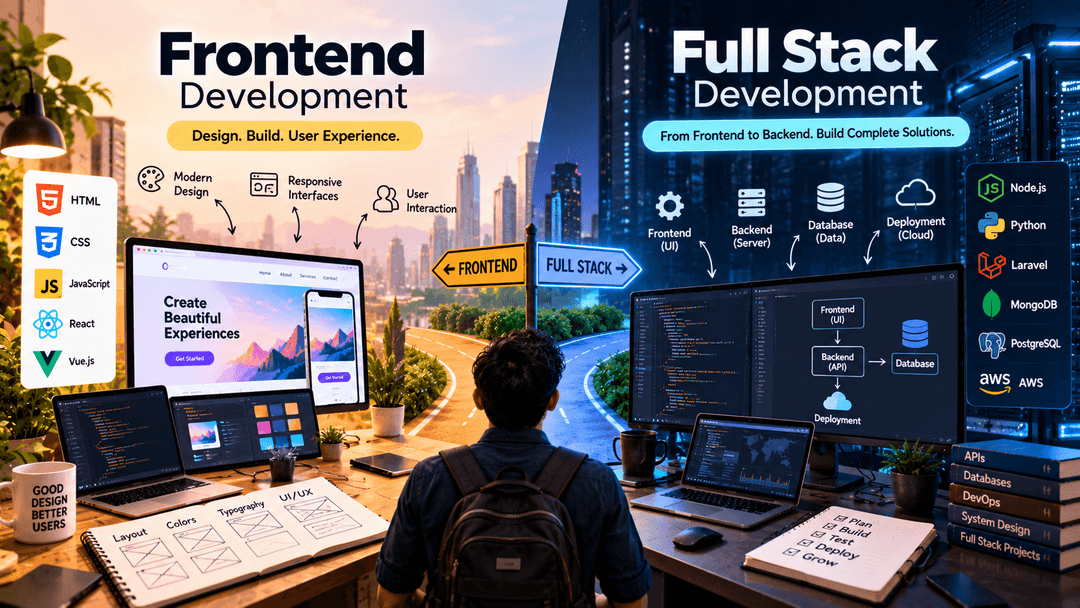

Web development offers different career paths, but choosing where to begin can be confusing. Two common options are frontend development and full stack development. Both involve building websites and web applications, yet they require different skills and responsibilities.
If you are comparing frontend vs full stack development, the main difference is the scope of work. Frontend developers focus on what users see and interact with, while full stack developers work on both user interfaces and the systems operating behind them.
This guide explains the technologies, responsibilities, learning requirements, and career opportunities associated with each path to help beginners make an informed decision.
What Is Frontend Development?
Frontend development involves building the visible and interactive parts of websites and web applications.
Everything users interact with, including navigation menus, buttons, forms, layouts, and responsive pages, forms part of the frontend.
Frontend developers turn designs into functional interfaces using programming languages, styling techniques, and modern development frameworks.
What Does a Frontend Developer Do?
A frontend developer is responsible for creating accessible, responsive, and user-friendly interfaces.
Typical responsibilities include:
Building website layouts and navigation systems
Developing interactive buttons, menus, and forms
Making websites responsive across different devices
Connecting interfaces with backend APIs
Improving accessibility and page performance
Testing functionality across browsers
For example, on an online shopping website, a frontend developer may create the product listing, shopping cart interface, and checkout form.
The primary goal is to make the application easy to use while ensuring its visual elements work correctly.
What Is Full Stack Development?
Full stack development covers both the frontend and backend of a web application.
While the frontend handles what users experience, the backend manages server-side operations, databases, authentication, and application logic.
A full stack developer understands how these parts connect and can contribute across the application.
What Does a Full Stack Developer Do?
Full stack developers may work on several areas of a project, including:
Creating responsive user interfaces
Developing server-side application logic
Designing and managing databases
Building and integrating APIs
Implementing user authentication
Testing, deploying, and maintaining applications
Consider an online shopping website. A full stack developer might create the product interface, build the backend that processes orders, and connect the application to a database.
Full stack development requires broader technical knowledge, although developers may still specialize in particular technologies.
Frontend vs Full Stack Development: Key Differences
The following comparison highlights the main distinctions between these two web development paths.
| Feature | Frontend Development | Full Stack Development |
|---|---|---|
| Primary Focus | User interface and interactions | Frontend and backend systems |
| Main Languages | HTML, CSS, JavaScript | JavaScript, SQL, and backend languages |
| Common Tools | React, Vue, Next.js | React, Node.js, Express, Django |
| Database Knowledge | Basic understanding is helpful | Practical database skills required |
| Main Responsibilities | Layout, usability, responsiveness | Interfaces, APIs, databases, server logic |
| Learning Scope | More focused | Broader technical coverage |
| Typical Projects | Landing pages, interactive interfaces | Complete web applications |
| Career Roles | Frontend Developer, UI Developer | Full Stack Developer, Web Application Developer |
Neither option is automatically better. The right path depends on your interests, learning goals, and preferred type of work.
Essential Skills for Frontend Developers
Frontend development combines visual understanding with practical programming skills.
HTML, CSS, and JavaScript
HTML defines the structure of web pages, CSS controls their presentation, and JavaScript adds functionality and interaction.
These three technologies form the foundation of modern frontend development.
Beginners should understand them before relying heavily on frameworks.
Responsive Web Design
Responsive design allows websites to adapt to mobile phones, tablets, and desktop computers.
Developers use flexible layouts, media queries, and techniques such as Flexbox and CSS Grid to create adaptable interfaces.
Frontend Frameworks
Frameworks and libraries help developers organize and build complex applications.
React is widely used for developing interactive interfaces, while Next.js provides additional application-building features.
Understanding component structure, state, and data handling becomes increasingly important as projects grow.
Additional Frontend Skills
Developers should also become familiar with Git, browser developer tools, accessibility, API integration, and performance optimization.
These skills support reliable development and effective teamwork.
Essential Skills for Full Stack Developers
Full stack developers need frontend knowledge alongside server-side development skills.
Backend Programming
Backend development manages business logic, data processing, and communication between applications and servers.
Common technologies include Node.js, Python with Django, PHP with Laravel, and other server-side frameworks.
Beginners should focus on one backend technology before exploring several alternatives.
Databases and Data Management
Databases store information such as user accounts, product details, and application records.
Popular database systems include PostgreSQL, MySQL, and MongoDB.
Full stack developers should understand data modeling, queries, relationships, and safe data handling.
APIs and Authentication
An application programming interface, or API, allows different software components to communicate.
For example, a frontend application may request product information from a backend API.
Authentication systems help verify user identities and manage access to protected features.
Deployment and Security
Full stack developers also benefit from understanding hosting, environment configuration, deployment, and application security.
These skills help transform a working project into an application that users can access reliably.
Which Development Path Is Easier for Beginners?
Frontend development generally offers a more focused starting point because beginners can see the results of their work directly in a browser.
Creating layouts, styling pages, and adding simple interactions provides immediate visual feedback.
Full stack development involves additional concepts, including backend programming, databases, APIs, and security.
However, this does not mean full stack development is unsuitable for beginners.
A practical approach is to learn frontend fundamentals first and gradually introduce backend technologies as your confidence improves.
Frontend vs Full Stack Development: Career Opportunities
Both career paths offer opportunities in software companies, digital agencies, technology teams, and freelance projects.
However, job responsibilities and employer expectations can vary considerably.
Frontend Developer Career Path
Frontend developers may work on websites, dashboards, digital products, and interactive applications.
With experience, they may specialize in interface engineering, accessibility, performance, or frontend architecture.
Their work frequently involves collaboration with designers, backend developers, and product teams.
Full Stack Developer Career Path
Full stack developers may contribute to complete applications, internal business systems, online platforms, and startup products.
Some positions require broad experience across several technologies, while others emphasize one primary stack.
Which Path Has Better Career Growth?
Career growth depends on practical skills, project experience, technical judgment, and changing employer requirements.
Full stack knowledge can increase the range of tasks a developer can perform, while deep frontend expertise remains valuable for complex user interfaces.
Neither title guarantees a higher salary or faster career progression.
Practical Learning Roadmap for Beginners
Following a structured roadmap can help learners avoid switching between technologies without building a strong foundation.
| Learning Stage | Frontend Path | Full Stack Path |
|---|---|---|
| Stage 1 | HTML, CSS, JavaScript | HTML, CSS, JavaScript |
| Stage 2 | Responsive layouts and Git | Responsive layouts and Git |
| Stage 3 | React and API integration | React and API integration |
| Stage 4 | Accessibility and performance | Backend programming and APIs |
| Stage 5 | Frontend portfolio projects | Databases and authentication |
| Stage 6 | Advanced UI development | Deployment and complete applications |
Beginner Frontend Project
Build a responsive portfolio website containing a homepage, projects section, contact form, and mobile-friendly navigation.
This demonstrates layout, styling, responsiveness, and basic JavaScript functionality.
Beginner Full Stack Project
Build a task management application where users can create accounts, add tasks, edit records, and save information in a database.
This provides experience connecting the frontend, backend, and data storage.
Both projects can become useful portfolio pieces when properly tested and documented.
How to Choose Between Frontend and Full Stack Development
Your decision should reflect the type of problems you enjoy solving.
Choose frontend development if you:
Enjoy visual design and interactive interfaces
Want to focus on user experience
Prefer seeing immediate results in the browser
Are interested in responsive websites and frontend applications
Consider full stack development if you:
Enjoy understanding complete application systems
Want to build both interfaces and server-side features
Are interested in databases and application logic
Prefer working across multiple technical areas
You do not need to make a permanent decision immediately. Many developers begin with frontend skills and expand into backend development later.
For structured learning, the GS Trainings web development course catalog includes both AI-Powered Frontend Development and Professional Full Stack Development programs.
Common Mistakes When Learning Web Development
Beginners can slow their progress by trying to learn too many technologies simultaneously.
Common mistakes include:
- Skipping programming fundamentals: Framework knowledge is less useful without understanding HTML, CSS, and JavaScript.
- Following tutorials without practice: Watching demonstrations does not replace building independent projects.
- Ignoring debugging: Learning to investigate errors is essential for both career paths.
- Avoiding Git: Version control helps developers track changes and collaborate.
- Building projects without finishing them: Completed, tested applications demonstrate stronger practical understanding.
A focused learning plan and regular practice help address these challenges.
Conclusion
Choosing between frontend and full stack development depends on your interests, technical goals, and preferred responsibilities.
Frontend development concentrates on building accessible, responsive, and interactive user interfaces. Full stack development expands that knowledge to include backend systems, databases, APIs, and application deployment.
For beginners, building a strong foundation in HTML, CSS, and JavaScript is a practical first step.
Consistent learning, completed projects, and hands-on experience are essential for developing skills in either career path.